
BACKGROUND
Senators of Rome is a political thriller negotiation game intended for 4-8 players. Each game is expected to last approximately one to two hours.
For 500 years, the Roman Senate, led by annually appointed consuls, governed the expanding Roman Republic. Conflict continuously threatened the very existence of the Republic and the balance of power between vying senators. Consuls assigned senators temporary powers to tackle severe crises. Failure spelled doom for their political career (and even the entire Republic). Success meant glory for the consuls and the senators involved. Ambitious senators capitalized on repeated success in a battle to claim rule as Emperor.
You are now joining the growing Roman Senate. Players compete and collaborate to secure power and stability for the Republic. Play well and you could become the next Emperor. Play carelessly, and your opponent will claim the title and end the Republic.
BASIC PLAY
The objective of the game is to gain the most victory points before reaching Civil War. Players take turns as consul, selecting participants to help pass a new historical event that threatens the Republic. Each turn includes a negotiation phase between the players and the consul to develop the event team and have the right resources to pass the event. Players use their limited political capital to bribe or even assassinate their opponents. Victory points are distributed after each event to either reward the participants who successfully passed the event or to recognize the abstaining participants if the event fails. The game ends with Civil War, the end of the Republic, and the player with the most victory points crowned Emperor to restore peace.
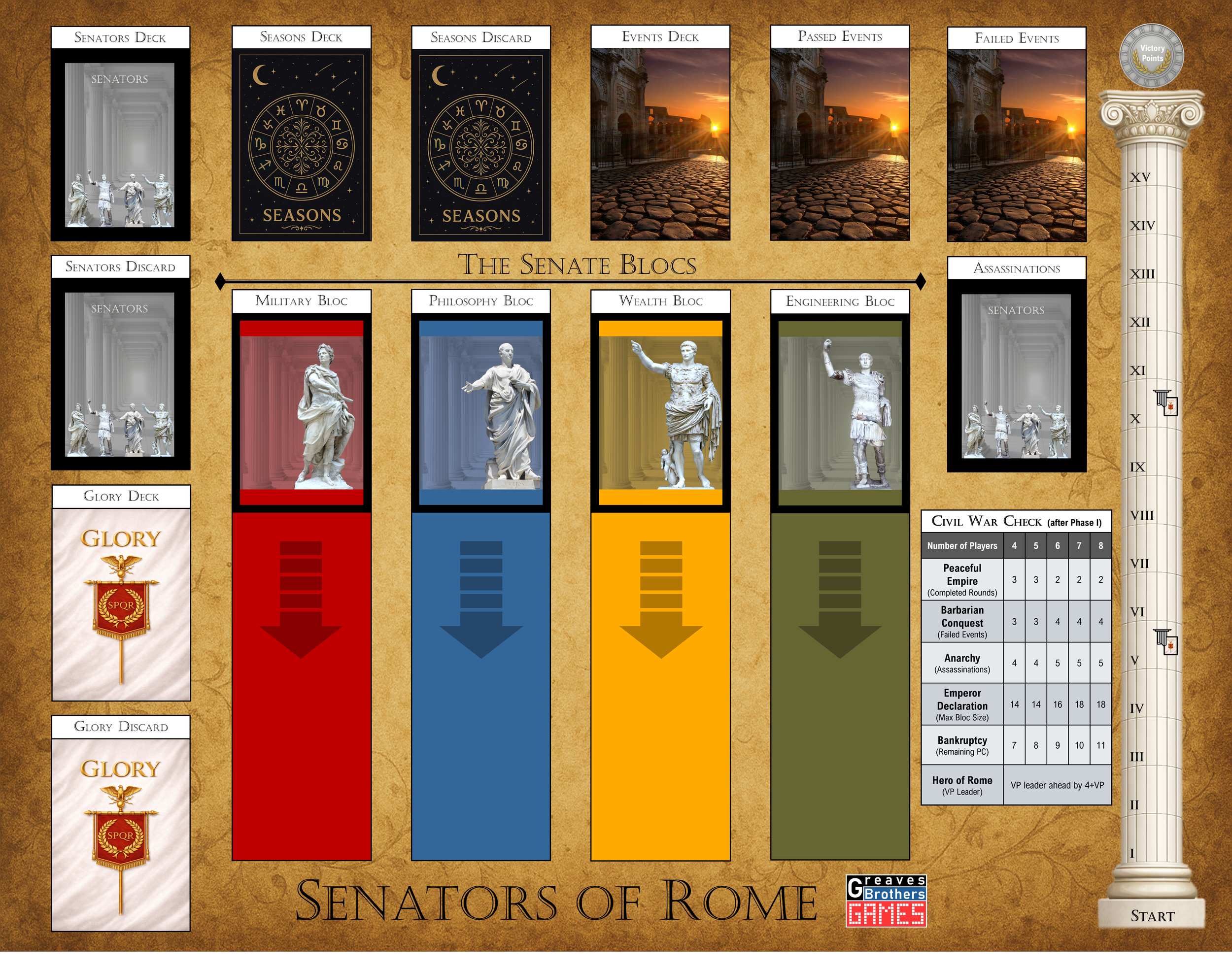
Senators of Rome comes with the following components:
100 unique Senator cards, used for negotiation and to resolve events
18 unique Event cards, representing historical events experienced by the Roman Republic. Completion of these events drives the distribution of victory points.
60 Glory cards, which are awarded as part of successfully passing the events.
30 unique Season cards, which change the rules for a turn.
Game Board, which includes victory point tracking, deck organization, and the Senate Blocs - where power builds and shifts throughout the game.
60 Political Capital tokens, which are used as a form of currency to negotiate actions.
8 unique Family Cards, which are passed out at the start of the game and provide family-specific powers to each player.
Senators of Rome Rulebook